
Posted on Leave a comment

The Science of Journaling: How Writing Can Rewire Your Brain

Introduction

Why People Feel Overloaded: And Why Thinking Isn’t Enough

Have you ever attempted to “think through” a problem, only to find yourself going in circles? You replay conversations. Revisit decisions. Reconstruct scenarios. Yet, instead of gaining clarity, your mind feels even more cluttered.

This is a common experience.

In a world brimming with constant stimulation, many individuals carry unprocessed thoughts and emotions. The brain keeps revisiting them not out of desire, but because it hasn’t fully processed them.

Psychological research indicates that merely thinking about emotions often falls short of resolving them. Without expression, thoughts tend to loop. This is where journaling for mental health proves to be powerful.

Writing accomplishes something that thinking alone cannot. It brings about structure, clarity, and emotional release.

What Happens in the Brain When We Write?

Writing Activates Emotional Processing

When you articulate your thoughts and feelings, two primary systems in the brain start to interact:

  • The limbic system (which governs emotions)
  • The prefrontal cortex (which oversees reasoning and control)

In times of stress, the limbic system tends to become hyperactive. This explains why emotions may seem overpowering or illogical. Engaging in writing activates the prefrontal cortex, enabling the brain to:

  • Structure emotional experiences
  • Lessen emotional intensity
  • Generate meaning from occurrences
  • Develop through neuroplasticity

This mechanism is referred to as emotional regulation.

The Role of Language in Reducing Stress

When you are feeling overwhelmed, your brain is not merely experiencing “stress”. It is undergoing biological activation. The amygdala, which serves as the emotional center of your brain, sends signals indicating that something is amiss. As a result, your heart rate increases, your thoughts become chaotic, and your system transitions into a subtle state of survival mode.

Now, here is where the topic becomes intriguing.

Articulating emotions is not solely an act of expression. It also serves a regulatory function.

In Cognitive-Behavioral Therapy, backed by neuroscience, this well-established phenomenon called affect labeling helps individuals identify and articulate their emotions better, leading to reduced anxiety and emotional distress by activating the prefrontal cortex and calming the amygdala. By consciously identifying your feelings with your psychologist or therapist, such as “I feel anxious,” “I feel overwhelmed, or “I feel stuck”, you engage the prefrontal cortex, the brain region associated with reasoning and self-control.

Consequently, this activation leads to a reduction in the activity of the amygdala.

In simpler terms, by naming your feelings, you initiate a calming effect in your brain. This explains why journaling, or engaging in writing therapy, often provides a sense of relief even in the absence of external advice. You are not merely “venting”. You are fundamentally altering your brain chemistry, transitioning from emotional reactivity to cognitive clarity.

Though it may seem like a minor action, neurologically, it represents a significant reset.

The Research Behind Expressive Writing (Inside and Outside Therapy)

A significant body of research in this domain originates from James W. Pennebaker (Jones et al., 2021). His findings revealed that individuals who documented emotionally impactful experiences exhibited enhancements in:

  • Psychological well-being
  • Immune function
  • Stress reduction

Participants who practiced expressive writing for merely 15–20 minutes across multiple days reported quantifiable mental health advantages. 

Additional studies disseminated by organizations such as the National Institutes of Health reinforce the connection between organized emotional expression and diminished cognitive stress.

Why Journaling Can Feel Like Therapy

From Chaos to Structure

Our mind is not disorganized due to any inherent flaw within. It is disorganized because unprocessed thoughts do not manifest as coherent sentences. Instead, they appear as fragments, partially formed concerns, recurring emotions, and incomplete internal dialogues.

When these thoughts remain unaddressed, they continue to cycle endlessly, and journaling serves to disrupt this cycle.

As soon as you begin to write, your brain is compelled to decelerate. It must arrange thoughts, select appropriate words, and construct a coherent narrative. This transition, from disjointed fragments to organized expression, alleviates cognitive overload and fosters clarity. Psychological research consistently indicates that merely contemplating emotions is insufficient for internal resolution. In the absence of expression, thoughts tend to recycle rather than be released.

This is where journaling for mental health proves to be immensely beneficial.

Writing accomplishes what mere thinking cannot. It organizes the disorder, provides your emotions with a space to settle, and establishes a sense of internal order that your mind has been striving to achieve all along.

Distance Creates Perspective

When thoughts remain confined within your mind, they often appear urgent, intertwined, and challenging to confront. Everything merges into a singular experience. You find yourself immersed in the moment. Responding in real time.

However, the instant you transcribe these thoughts, a transformation may occur. Those identical thoughts transition from an internal state to an external one. This shift engenders psychological distance. Rather than being ensnared by the emotion, you can begin to observe it, similar to stepping back and viewing it from an external vantage point.

This process transcends mere sensation. It is a technique employed in structured therapeutic approaches such as Mindfulness-Based Cognitive Therapy and Acceptance and Commitment Therapy. The objective is straightforward. It aims to detach you from your thoughts, enabling you to scrutinize inner judgments, reframe external pressure, and respond with greater intention.

It is within this subtle transition from reacting to observing that clarity emerges.

Journaling as a Tool in Modern Therapy

On platforms such as WHJ Online, structured writing is not merely encouraged. It serves as a guided intervention method.

Written therapy enables individuals to:

  • Process their emotions at a comfortable pace
  • Express themselves without the fear of being judged
  • Revisit their thoughts with enhanced clarity

Dr. Anney Roy highlights:

“Writing provides individuals with a secure environment to face emotions they might not yet be prepared to vocalize. It assists in transforming overwhelming feelings into something comprehensible and manageable. That’s why your homework beyond therapy is important. It is reshaping your mind and saving your life.”

This methodology aligns with contemporary therapeutic models that prioritize self-reflection, (self)awareness, and the gradual processing of emotions.

Understanding Your Mind: When Deeper Insight Helps

At times, persistent patterns of thought and emotion necessitate a more profound comprehension. Instruments in the Cognitive Health Check-Up offer a systematic psychological assessment. This evaluation aids in recognizing:

  • Personality patterns
  • Emotional tendencies
  • Cognitive reactions to stress

When utilized alongside journaling, these tools can greatly enhance self-awareness and emotional management.

How to Start a Therapeutic Journal

One does not have to be a writer to gain advantages from journaling. Begin with simplicity.

1. Emotional Release Writing

  • Express your feelings without restraint
  • There is no need for structure or judgment
  • This practice aids in alleviating emotional tension

2. Reflective Writing

Pose the following questions to yourself:

  • What emotions did I experience today?
  • Why did I feel this way?
  • What prompted this reaction?

This process enhances self-awareness.

3. Pattern Recognition

With time, journaling enables you to identify:

  • Recurrent thoughts
  • Emotional triggers
  • Behavioral patterns

This is where real transformation begins.

Writing Prompts Used in Therapy

Utilize these prompts to direct your writing sessions during self-therapy:

  • Which emotion did I feel most intensely today?
  • What circumstance provoked that emotion?
  • How did I react, and what was the reasoning behind it?
  • What is something I require at this moment that I am failing to recognize?
  • What is a single thought I can reinterpret today?

These prompts encourage deep psychological reflection.

The Biochemistry of Emotional Relief

When emotional stress is managed effectively, the body reacts positively. Potential benefits may encompass:

  • Lowered cortisol (the stress hormone) levels
  • Improved sleep quality and sleep hygiene
  • Enhanced immune function

Studies suggest that expressing emotions diminishes physiological stress reactions, enabling the body to regain equilibrium.

This is why journaling for mental health is not just psychological. It is physiological.

Conclusion

In a world brimming with endless distractions, numerous individuals harbor unexamined thoughts that subtly influence their mental well-being. Journaling provides a unique opportunity, a moment of stillness. It enables the mind to slow down, reflect, and reorganize. It converts disordered thoughts into coherent insights. Often, that is precisely what the mind requires to start the healing process.

Follow the Three-Part Series Here

  1. Mental Exhaustion in 2026: Why Everyone Feels Burnt Out (and How to Recover)
  2. The Science of Journaling: How Writing Can Rewire Your Brain
  3. The Loneliness Epidemic: Why People Feel More Alone Than Ever

References

Abu-Odah H, Su JJ, Wang M, Sheffield D, Molassiotis A. (2023). Systematic review and meta-analysis of the effectiveness of expressive writing disclosure on cancer and palliative care patients’ health-related outcomes. Support Care Cancer. https://doi.org/10.1007/s00520-023-08255-8

Jones, J. K., Evans, J. F., & Barfield, R. C. (2021). The Utility of Verbal Therapy for Pediatric Cancer Patients and Survivors: Expressive Writing, Video Narratives, and Bibliotherapy Exercises. Frontiers in pediatrics9, 579003. https://doi.org/10.3389/fped.2021.579003

Litz, B. T., Orsillo, S. M., Kaloupek, D., & Weathers, F. (2000). Emotional processing in posttraumatic stress disorder. Journal of Abnormal Psychology, 109(1), 26–39. https://doi.org/10.1037//0021-843x.109.1.26

Stuckey, H. L., & Nobel, J. (2010). The connection between art, healing, and public health: a review of current literature. American journal of public health100(2), 254–263. https://doi.org/10.2105/AJPH.2008.156497

Wang, H. Y., Li, L. Z., Chang, Y., Pang, X. M., & Zhang, B. W. (2024). Impaired implicit emotion regulation in patients with panic disorder: An event-related potential study on affect labeling. World Journal of Psychiatry14(2), 234–244. https://doi.org/10.5498/wjp.v14.i2.234

WHJ Cognitive Health Check-Up (MMPI-2)

Author Bio

Saptashwa Ganguly is a graduate in media science, a storyteller, and a content strategist with experience in both written and visual communication. Alongside a diverse educational background, he offers a distinctive combination of creativity and clarity in his work across performing arts and digital content creation. Saptashwa focuses on developing engaging, research-based content across various industries, transforming intricate concepts into captivating narratives that educate, connect, and motivate readers.


Published under the Creative Commons Attribution 4.0 International (CC BY 4.0) license for mental health awareness with editorial review.

Posted on Leave a comment

Mental Exhaustion in 2026: Why Everyone Feels Burnt Out (and How to Recover)

Introduction

The Silent Epidemic of Mental Exhaustion

Let’s begin with a scenario. You wake up feeling drained, despite a full night’s sleep. Before your day even starts, your phone buzzes with notifications, emails, messages, and other updates. Your brain begins to juggle everything simultaneously. By the time you settle down to work, you’re not physically worn out, but mentally, something already feels amiss.

This is the experience of millions of individuals today.

Many believe this ongoing fatigue stems from overworking. However, modern psychology indicates a deeper issue. An escalating wave of mental fatigue is caused not only by workload but also by relentless cognitive overload and allostatic load. According to global psychological studies, increasing stress levels are no longer confined to the workplace. They have seeped into daily life, from digital engagement to emotional strain.

Recognizing this change is the initial step towards healing.

So, what is mental exhaustion, exactly?

What Mental Exhaustion Actually Is

Mental exhaustion, often called mental fatigue, is more than just a fleeting sense of tiredness. It signifies a genuine change in your brain’s psychobiological condition following extended periods of intense cognitive effort. Research in neuroscience and performance psychology consistently indicates that mental fatigue diminishes attention span, impairs decision-making, and delays reaction times. Recent studies have taken this further. It not only impacts your mental state but also decreases physical stamina, making tasks feel more challenging even when your body is fully capable.

Stress vs Burnout

To grasp this concept effectively, it’s essential to distinguish it from stress and burnout. Stress is typically a short-lived reaction to immediate pressures or challenges. In contrast, burnout is a long-term condition that accumulates over time, resulting in profound emotional exhaustion, cynicism, and detachment. Mental exhaustion occupies a middle ground; it serves as an early warning signal, indicating that your brain is nearing overload before it escalates into complete burnout.

Common Signs of Mental Exhaustion

Mental exhaustion does not strike suddenly; it accumulates gradually.

You may observe ongoing mental fatigue even after periods of rest. When you attempt to concentrate, your mind may feel clouded, almost as if it refuses to cooperate. Minor irritations may begin to affect you more than they should. Your motivation may wane. You might even find yourself withdrawing from social interactions, not out of desire, but because everything seems to require excessive effort.

On a neurological level, this phenomenon is not arbitrary. Extended cognitive strain diminishes your brain’s capacity to manage attention and emotions effectively. In simple terms, your system is overwhelmed and is attempting to safeguard itself by slowing your pace.

This leads us to a critical inquiry. If so many individuals are facing this challenge, what exactly is overburdening our brains today?

Why Do So Many People Feel Burnt Out Today?

1. Information Overload and Cognitive Fatigue

Contemporary existence necessitates unwavering focus. Emails, alerts, social media, and news all vie for cognitive resources. This results in cognitive overload, making it difficult for the brain to manage an overwhelming amount of information. The resulting wear and tear of the mind and body is called allostatic load.

Studies conducted by Stanford University indicate that habitual multitasking diminishes attention regulation and memory efficacy. In simple words, the more we alternate between tasks, the more mentally fatigued we become.

2. Social Media Comparison

Social media not only takes up time, but it also drains emotional energy.

The continuous exposure to carefully curated lives fosters subtle cycles of comparison. As time progresses, this results in:

  • Self-doubt
  • Emotional fatigue
  • Reduced self-worth

This type of digital burnout is among the most frequently overlooked contributors to emotional exhaustion in contemporary society.

3. The Always-Online Work Culture

The distinction between work and personal life has become increasingly ambiguous. The rise of remote work, international teams, and digital communication has obscured the separation between “work” and “leisure.” Consequently, numerous individuals suffer from chronic stress symptoms without being aware of it, as they are perpetually connected.

Now, if constant overload is the trigger, the real question becomes deeper. What does this sustained pressure actually do to us psychologically over time?

Let’s get into the psychology of burnout.

The Psychology Behind Burnout

Allow me to guide you through the underlying mechanisms at play because once you gain a clear understanding, it ceases to appear so arbitrary.

How Chronic Stress Affects the Brain

When stress becomes a persistent state, your body struggles to ‘turn off.’ It continues to produce cortisol, the hormone that helps you respond to stressors. In brief episodes, this is beneficial. However, when cortisol levels remain elevated for an extended period, it begins to work against your well-being.

Over time, this chronic stress can impair your memory, hinder your concentration, and disrupt your emotional regulation. You may find yourself forgetting minor details, having difficulty focusing, or reacting more strongly than usual. This is not a sign of you ‘losing control’, it is your brain functioning under prolonged pressure.

Neuroscientific studies consistently indicate that extended stress diminishes cognitive abilities and hastens mental exhaustion. Consequently, even straightforward tasks, such as responding to a message, making a decision, or initiating work, can suddenly become daunting during periods of burnout. Your brain is not being inefficient; it is simply overwhelmed.

Decision Fatigue and Mental Drain

Now, consider this additional layer. Each day, you face countless micro-decisions. What to eat, what to communicate, what to prioritize, what to disregard. While many of these choices seem trivial, collectively, they gradually deplete your mental resources.

This phenomenon is referred to as decision fatigue. The more decisions you are required to make, the more challenging each subsequent choice becomes. Clarity diminishes. Motivation wanes. Even the act of determining your next step can feel laborious.

Moreover, here is a crucial aspect that many overlook. Burnout is not solely a result of excessive activity. It frequently stems from excessive, continuous contemplation that doesn’t allow your mind time to recover.

Here, a pertinent question arises. If this is the process through which burnout accumulates, how can one effectively reverse it?

How to Recover from Mental Exhaustion

Let’s pause for a moment because recovery does not entail turning your life upside down. It is not about extreme routines or sudden discipline. It begins in a much simpler manner. Small, deliberate changes that communicate to your brain. You are safe. You can relax now.

1. Reset the Nervous System

At this moment, your system may be trapped in a perpetual “on” state. The brain has not received sufficient signals indicating rest. This is where simple actions come into play, such as walking in natural light, engaging in deep breathing, and minimizing sensory input. These are not arbitrary wellness suggestions. They directly influence your nervous system, helping your body transition out of survival mode and gradually alleviating mental fatigue.

2. Create Digital Boundaries

Your brain is not merely fatigued; it is overstimulated. Constant notifications, endless scrolling, and early-morning screen exposure fragment your attention even before your day commences. Therefore, we do not eliminate technology; we establish boundaries. Disabling non-essential notifications, designating no-screen time intervals, and avoiding social media in the early hours of the day. These minor restrictions provide your mind with something it has been lacking, i.e., space.

3. Reflective Writing

This is where the discussion deepens. Writing serves not only as a means of expression but also as a method of processing. At WHJ, written emotional expression is used as a structured therapeutic approach because it helps process unresolved emotions, understand thought patterns, and alleviate mental pressure. Research conducted by James Pennebaker (2011) indicates that expressive writing enhances psychological well-being and diminishes stress. This is logical when thoughts remain confined in your mind; they remain chaotic. When you transcribe them, they begin to take form.

4. When Professional Support Helps

There are instances when self-regulation falls short, and that is perfectly acceptable. Therapeutic dialogues, including written therapy, foster an environment where you do not bear everything alone. You start to recognize patterns, identify triggers, and rebuild mental resilience with guidance.

5. A Simple Daily Reset Routine

What truly makes a difference is what you can consistently practice. So, focus on rhythm rather than intensity.

  • Morning: Refrain from using your phone right away, soak in some sunlight.
  • Midday: Take brief breaks from screens, step away from your work environment.
  • Evening: Engage in reflection through journaling, minimize stimulation before bedtime.

These may seem like small adjustments, but when practiced regularly, they effectively combat chronic stress symptoms and cognitive overload.

Here’s the key point. You don’t have to resolve everything in one night. You simply need to start.

Once you grasp this, a natural question arises. If recovery is achievable, what does it truly entail in the long term?

Conclusion

If you’ve found yourself relating to this, take a moment to breathe. This part is crucial. Mental fatigue is not a sign of personal failure. It doesn’t mean you’re “falling behind or “not putting in enough effort”. It’s simply your mind reacting as it’s meant to when faced with ongoing stress, constant stimuli, endless decisions, and a heavy emotional burden.

We exist in a culture that values speed, urgency, and relentless involvement. So when your energy wanes, your concentration falters, or you feel a sense of disconnection, that’s not a sign of dysfunction; it’s a signal.

Here is another key point. Recovery is achievable not by pushing yourself harder, but by grasping what’s truly occurring within you. When you start to identify burnout for what it is and consciously carve out time for rest, reflection, and emotional processing, you enable your mind to reset. That’s when clarity returns. That’s when equilibrium begins to restore.

You don’t require a complete overhaul. What you need is a small, steady permission to take a break. At times, the most impactful move forward isn’t about doing more. It’s about slowing down just enough to finally reconnect with your own thoughts.

Follow the Three-Part Series Here

  1. Mental Exhaustion in 2026: Why Everyone Feels Burnt Out (and How to Recover)
  2. The Science of Journaling: How Writing Can Rewire Your Brain
  3. The Loneliness Epidemic: Why People Feel More Alone Than Ever

References

American Psychological Association. (2023). Stress in America™ survey. American Psychological Association. https://www.apa.org/pubs/reports/stress-in-america

Bianchi, R., & Schonfeld, I. S. (2023). Examining the evidence base for burnout. Bulletin of the World Health Organization, 101(11), 743–745. https://doi.org/10.2471/BLT.23.289996

Koutsimani, P., Montgomery, A., Masoura, E., & Panagopoulou, E. (2021). Burnout and Cognitive Performance. International Journal of Environmental Research and Public Health, 18(4), 2145. https://doi.org/10.3390/ijerph18042145

Pennebaker, J. W., & Chung, C. K. (2011). Expressive writing: Connections to physical and mental health. In H. S. Friedman (Ed.), The Oxford Handbook of Health Psychology (pp. 417–437). Oxford University Press. https://psycnet.apa.org/record/2013-01232-018

World Health Organization. (2019). Burnout: An occupational phenomenon: International classification of diseases. https://www.who.int/standards/classifications/frequently-asked-questions/burn-out-an-occupational-phenomenon

Author Bio

Saptashwa Ganguly is a graduate in media science, a storyteller, and a content strategist with experience in both written and visual communication. Alongside a diverse educational background, he offers a distinctive combination of creativity and clarity in his work across performing arts and digital content creation. Saptashwa focuses on developing engaging, research-based content across various industries, transforming intricate concepts into captivating narratives that educate, connect, and motivate readers.


Published under the Creative Commons Attribution 4.0 International (CC BY 4.0) license for mental health awareness with editorial review.

Posted on 1 Comment

How Post-Traumatic Stress Disorder and Stigma Impact Parenting

Introduction

Every family faces its own challenges and experiences. For parents who have experienced traumatic events, resulting in Post Traumatic Stress Disorder (PTSD), there may be additional challenges. Studies have examined the effects of PTSD and how PTSD in parents can affect children who have not been exposed to the same traumatic events. These studies have found a variety of effects, but in the end, safely examining PTSD within the family is a difficult task for the members of the family. This warrants professional help.

What Is PTSD?

PTSD is a condition that can develop in anyone of any age. It is caused by a traumatic event or series of events, such as a disaster, accident, assault, or other serious event. The symptoms of PTSD can include flashbacks, distressing thoughts, avoidance behaviors, being easily startled, and more.

How Does PTSD Affect Parenting?

There are a variety of studies on how PTSD in parents affects children. However, each study uses different methods of collecting data and measuring the impact of PTSD.

Overall, existing studies show several major impacts. First, PTSD can cause emotional detachment in parents. This affects the parent-child relationship and can result in disorganized detachment, where children are unable to develop a stable strategy for coping with distress (van Ee et al., p. 192, 2016). Another possible impact is the impairment of self-regulation in children. Impaired regulation results in an exaggerated stress response and difficulty dealing with stressful situations (van Ee et al. 194-95, 2016). Finally, parenting stress is heightened and satisfaction lowered in parents struggling with PTSD (Christie et al., p. 4-7, 2016).

However, it is not easy to measure the impact of PTSD. Not only is each family different, but traumatic experiences are complex, and each individual’s response to them will vary (van Ee et al., p. 195, 2016). Additionally, many studies of PTSD in parents rely on self-report measures. Combined, these factors make studying PTSD difficult.

At the end of the day, every case is unique in one way or another. Each family situation is affected by many different factors, and it is not easy to predict what role trauma will play. Studies have found that child development and parent-child relationships can be affected. However, PTSD manifests in many different ways, and each parent’s reaction to it and the way PTSD affects their parenting style will vary (van Ee et al., p. 194-95, 2016).

None of this is to say that a parent with PTSD cannot have a successful and fulfilling relationship with their child. Using therapy to find healthy coping tools and healing is a valuable first step to living with PTSD as a parent or as an individual without children. The first step is combating mental health stigma.

The Impact of Mental Health Stigma

Sometimes, taking care of our mental health can feel like a big challenge. Between busy schedules and budget concerns, there are many things that make seeking mental healthcare difficult. However, beyond busy schedules and accessibility, one big factor that stops people from taking care of their mental health is the stigma surrounding mental illness and mental healthcare.

Stigma is a set of negative assumptions or associations people have about something.

When it comes to mental health, stigma can take many forms. For example, a person assumes that someone with a mental health condition is violent or dangerous, or assumes that a person with a mental health condition is weak or looking for attention (Sickel et al., p. 586-587, 2019). Stigma can also cause people to see mental illness as strange or uncommon, but according to the World Health Organization (2022), 1 in every 8 people in the world lives with one.

The effects of stigma are two-fold and occur on both an individual and societal level (Corrigan & Watson, p. 16-18, 2022). On an individual level, mental health stigma often prevents people from seeking mental healthcare. Stigma directly influences a person’s attitude toward treatment by giving them a negative view of mental illness and of seeking treatment. It also influences people indirectly by decreasing their sense of self-esteem and self-efficacy, further increasing their anxiety. All of these aspects may make several parents less likely to seek treatment (Sickel et al., p. 593, 2019), especially for PTSD, thus affecting their parenting styles.

The reason stigma has such power is because parents who might or might not be struggling with mental health conditions may often look for social and familial validation of their identity and voice, instead of utilizing parenting techniques that are relevant for their children, which may vary from family to family. When stigma is present, negative attitudes are internalized by the individual (Sickel et al., p. 594, 2019), in this case, both parents and children. Therefore, it is important that parents help their children develop positive heuristics and relational schemas before they encounter situations that may trigger stigma or misunderstanding about mental health. It is crucial for parents to actively engage in discussions about mental health, ensuring their children grasp the importance of understanding and empathy. By instilling these values early on, children are better prepared to navigate societal challenges and support themselves and others in the face of stigma.

Ways to Prevent Stigma

Sickel et al. (p. 595, 2019) suggest limiting the power of stigma by encouraging primary care providers, i.e., the doctor you would usually go to for help with your routine medical check-up, to regularly screen their patients for mental health conditions, especially when signs of mental health concerns are present. This could help parents with mild to moderate mental health conditions who would not otherwise seek out a mental health professional to receive treatment that could help them and their children.

To further prevent the negative effects of mental health stigma and the underlying PTSD, we can also consider how to stop self-stigma from spreading (Corrigan & Watson, 2022). To combat stigma, the National Alliance of Mental Illness (NAMI, 2017) suggests being willing to talk openly about mental health, educating yourself and others about mental health topics, normalizing therapy by being honest about seeking treatment, and showing compassion to those dealing with a mental health condition. Each of these methods weakens stigma by normalizing discussions around mental health treatment and educating people on what mental healthcare looks like. Furthermore, these practices combined can help heal global PTSD, starting from a communal level.

Conclusion

Stigma can be a powerful force, shaping us in ways we might not even realize. In today’s world, dealing with the effects of the loneliness pandemic and the rise of global technology, taking care of our mental health is a challenge, and stigma makes it even more difficult. However, if we can educate ourselves and others on the effects of stigma and learn to be open about the importance of mental healthcare, we can help ourselves and others overcome post-traumatic stress disorder collectively.

References

Corrigan, P. W., Watson, A. C. (2002). Understanding the impact of stigma on people with mental illness. World Psychiatry, 1(1), 16-20. https://www.ncbi.nlm.nih.gov/pmc/articles/PMC1489832/

Christie, H., Hamilton-Giachritsis, C., Alves-Costa, F., Tomlinson, M., & Halligan, S. L. (2019). The impact of parental posttraumatic stress disorder on parenting: A systematic review. European Journal of Psychotraumatology10(1), 1-13. https://doi.org/10.1080/20008198.2018.1550345

NAMI. (2017). 9 ways to fight mental health stigma. National Alliance of Mental Illness. https://www.nami.org/Blogs/NAMI-Blog/October-2017/9-Ways-to-Fight-Mental-Health-Stigma

Sickel, A. E., Seacat, J. D., Nabors, N. A. (2019). Mental health stigma: Impact on mental health treatment attitudes and physical health. Journal of Health Psychology, 24(5), 586-599. https://doi.org/10.1177/1359105316681430

van Ee, E., Kleber, R. J., & Jongmans, M. J. (2016). Relational patterns between caregivers with PTSD and their nonexposed children: A review. Trauma, Violence, & Abuse17(2), 186-203. https://doi.org/10.1177/1524838015584355

WHO. (2022). Mental disorders. World Health Organization. https://www.who.int/news-room/fact-sheets/detail/mental-disorders

Author Bio

Nora is an international student from the USA. She was studying in the Czech Republic for her master’s. Her focus is on the School of Humanities and Social Sciences. She is especially interested in exploring how self-talk and self-awareness affect mental health within queer communities.

“Through my experience as a student living abroad, I’ve learned a lot about taking care of my mental health and handling big life changes. In my free time, I’m an avid reader, knitter, and artist. At WHJ Online Therapy Centre, I worked as a content writing intern, expanding my knowledge of mental health and self-help tools.” – Nora Zapalac


Published under the Creative Commons Attribution 4.0 International (CC BY 4.0) license for mental health awareness with editorial review.

Posted on Leave a comment

Thoughts on Social Media Posts about Mental Health

To make sense of your sadness and then heal from depression, negative memories, anxiety, health issues

It wasn’t too long ago that I saw something on Instagram that caught my attention. It was a post by an old college classmate of mine which said something along the lines of, “If you are ever feeling low, if you have something on your mind, please reach out to me and we can talk about it.” Now that post irritated me and I guess it’s just my anger issues cropping up but nonetheless, that post was thought provoking and I am here to tell you why.

I have had my fair share of mental health issues and I continue to work on them. I seek therapy often and I find that it helps me recognize and resolve the many issues that I face. And I want to stress on the important role therapy plays in deciphering, recognizing and resolving many mental health concerns and I want to make this clear, if you have issues that you find overwhelming, please visit a registered therapist and seek professional help. Do not fall prey to social media posts where untrained, attention seeking netizens claim to be there to help you. They have no idea what they are doing and more importantly you are confiding your deepest fears with them and this kind of granular personal information needs to be handled securely by a professional and not someone who puts up a post (unless they are from the professional background).

Therapy involves a lot of confidentiality and a lot of work. People who are not trained will not be able to handle such sensitive information nor have the right tools to efficiently protect your data. Many times speaking to untrained people can seem like a futile exercise and may add to the stress that you are facing. Those who think they can resolve people’s issues by declaring via social media that they are available to lend an ear – until and unless you are a trained health professional, don’t try to “resolve” someone’s mental health issues without proper training and experience. This could also be stressful personally. I would compare such a situation to giving a monkey the responsibility of maintaining a nuclear reactor, it is bound to cause a meltdown and if Chernobyl is anything to go by then there is no coming back from it.

I understand that mental health comes at a very steep price and these prices render it unaffordable for the majority of people and with stigma surrounding therapy you might feel like you do not want to seek help and put tags on your issues such as depression or anxiety but trust me a therapist is better suited to understand and resolve the issues that you face at the earliest and there are many pocket friendly ways in which you can seek professional help in your country.

I understand that it is a tough time and you don’t have to look too far for help.


Published under the Creative Commons Attribution 4.0 International (CC BY 4.0) license for mental health awareness with editorial review.
 

Posted on Leave a comment

Nikita’s Journey into Therapy

Nikita’s Journey into Therapy

For Anney

Needless to say, last year has been an absolute shit show. It was quite literally the most stressful I’ve ever been in my life and getting out of it has taken a lot of conscious effort. 

In March of 2020, right before the lockdown in India, I had a pretty sorted life. I had a job I loved, a wonderful apartment, a great set of friends and a loving partner. But in a matter of months literally everything unravelled. 

It began with my parents getting no income because of the lockdown. I was stuck in my hometown away from where I’ve been living for the last 6 years. I used to work for a travel company, so while I was lucky to still have a job (especially since about 40% of my company was furloughed), I hated the role I was given due to the reorganization that consequently happened. I was suddenly in a long distance relationship with no prep and things were just hard. No one really saw it coming and no one knew how long it was going to last for. 

3 months later, there was still not much change in the situation. But I went back to Bangalore where I was living and met my boyfriend and started looking for another job. I luckily got a much better offer and things were beginning to look better for me. However things at home were getting worse and there was a lot of guilt associated with staying alone and spending so much money when I could be back home and support my family that has 4 adults. So after much protest from my boyfriend, I packed all my things and moved back home. 

That put a real strain on my relationship. Things at home was very stressful and I became the mediator between all the adults fighting at home. Literally everything made me cry and I felt helpless and my boyfriend started shutting me out at this very point which ultimately pushed me over my limit. I knew I needed help and my friends were wonderful. They were always there for me if I wanted to talk. But if you are anything like me, even that started making me feel guilty because I didn’t want to depend on them too much, because I’m sure they had things happening in their life too and I was in no situation to support them. 

I finally turned to therapy. I just needed someone to talk to. To help me sort out all the stress, anxiety and fear I was feeling. When I started therapy I knew a break up with my boyfriend was inevitable and it did happen. I was depressed for the next couple of months and I was constantly crying and lost a lot of weight. And this was not something I could talk about with my family. I had completely lost sight of who I was as a person which was a huge shock in itself, because I have always had a very strong sense of self. 

I had very flexible working hours and I was anyway working from home, so it was becoming hard to differentiate day and night, weekdays and weekends. Therapy was something that I started looking forward to. It was a much needed pause to an otherwise endless blob. Recollecting the past week helped when there is an active listener making note of everything that I say and guiding me through it, one step at a time. Therapy really helped me go back to who I was. It helped me figure out what I can compromise on and what I cannot. It helped me set boundaries and not feel guilty about things that were not my fault. It helped me accept the fact that I cannot control everything happening around me and it really just helped me during a very hard time in my life. 

This was 7 months ago and a lot has happened since then. My parents are still financially strained, but things are better after making some hard decisions. I took a solo trip for a month, just to get a change in environment that really really helped me. By A LOT. I applied for my masters and am all set to begin in the next few months. After struggling with my new job in the beginning with everything else that was happening in my life, it’s currently going really well. My ex boyfriend also reached out to me wanting to fix things and while that is gonna take more time, we are working on figuring things out. 

The past year was difficult but I have learnt a lot about myself as a person. It came with a lot of hard lessons and through it all, I have continued therapy. 


Published under the Creative Commons Attribution 4.0 International (CC BY 4.0) license for mental health awareness with editorial review.

Posted on Leave a comment

Pranav’s Case – Detachment

Dissociation Online Therapy

Do you find similarities between yourself and Pranav?

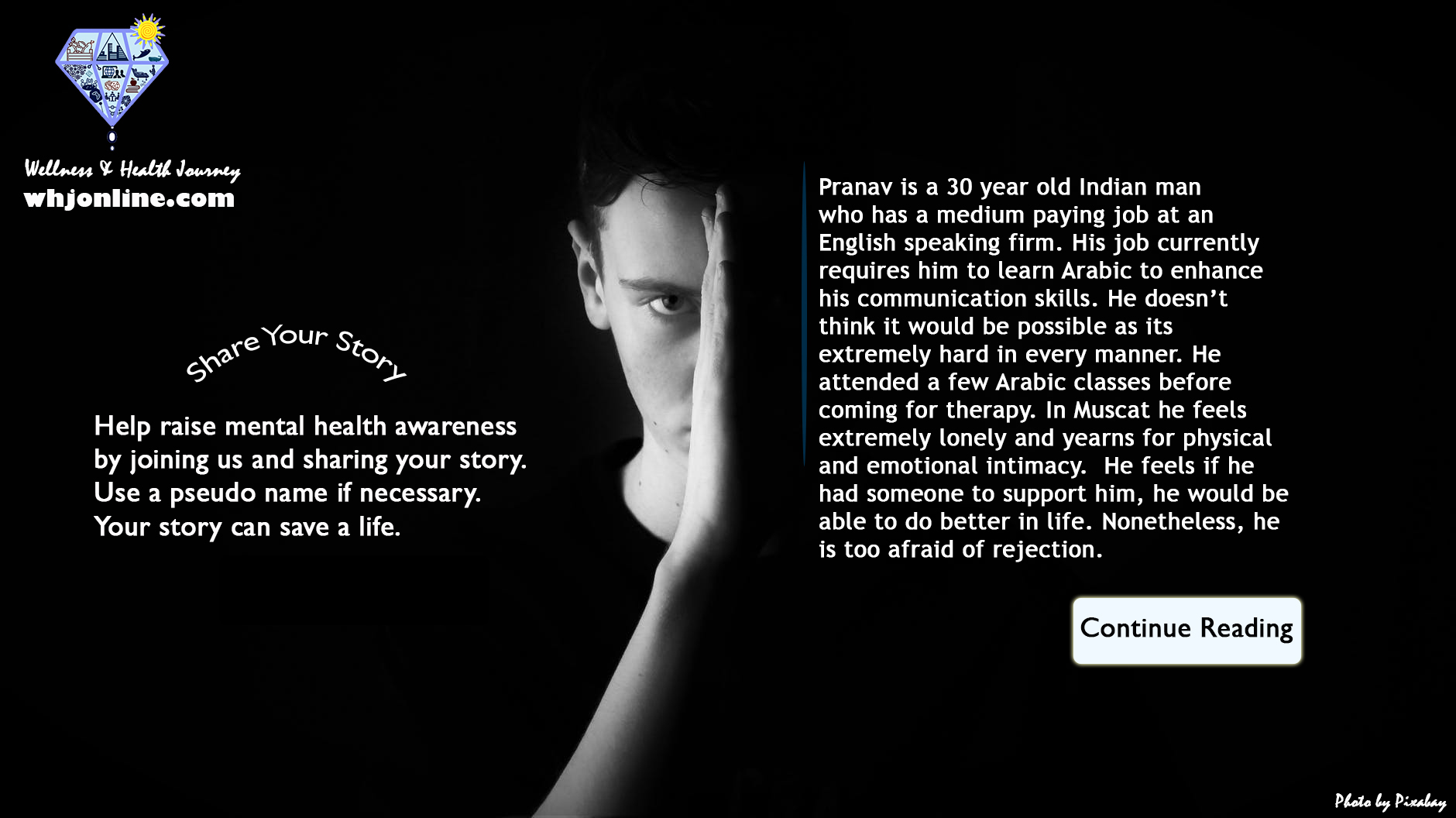
Pranav is a 30 year old Indian man who has a medium paying job at an English speaking firm. His job currently requires him to learn Arabic to enhance his communication skills. He doesn’t think it would be possible as its extremely hard in every manner. He attended a few Arabic classes before coming for therapy. In Muscat he feels extremely lonely and yearns for physical and emotional intimacy. He feels if he had someone to support him, he would be able to do better in life. Nonetheless, he is too afraid of rejection. He changes the topic every time someone tries to make him meet someone new. He also says that he would hurt his ex girlfriend more than everything. He maintains a platonic friendship with her. She finds it hard to completely let go of the possibility of them resuming their relationship in the future as he appears to be consistent and stable, and represents safety, familiarity and “no risk”. She is currently in Muscat.

He has been considering moving back to India. He is certain he would be able to find a less demanding job there. He hopes that the cultural and language similarities could also make it much easier to meet someone new. However, he worries about starting over and making a new life for himself there.  Another thought that distresses him is that it would be quite disappointing and lonely if he moved but didn’t meet anyone.

Pranav has been terrified by the reality of passing time, especially during the time of corona virus pandemic. This has brought up feelings of dying without achieving anything meaningful in life. He feels emotionally paralysed and caught between what he calls “death anxiety” and “life anxiety”.

Pranav is currently undergoing existential therapy.  He has been to therapy before but ends up withdrawing when he feels disappointed and that the therapy is not living up to his expectations. He decided to start the 8 weeks therapeutic journey to try and resolve his issues of detachment. If you found similarities between yourself and Pranav, our team would be able to help you too.

Personal details have been changed to preserve confidentiality.